
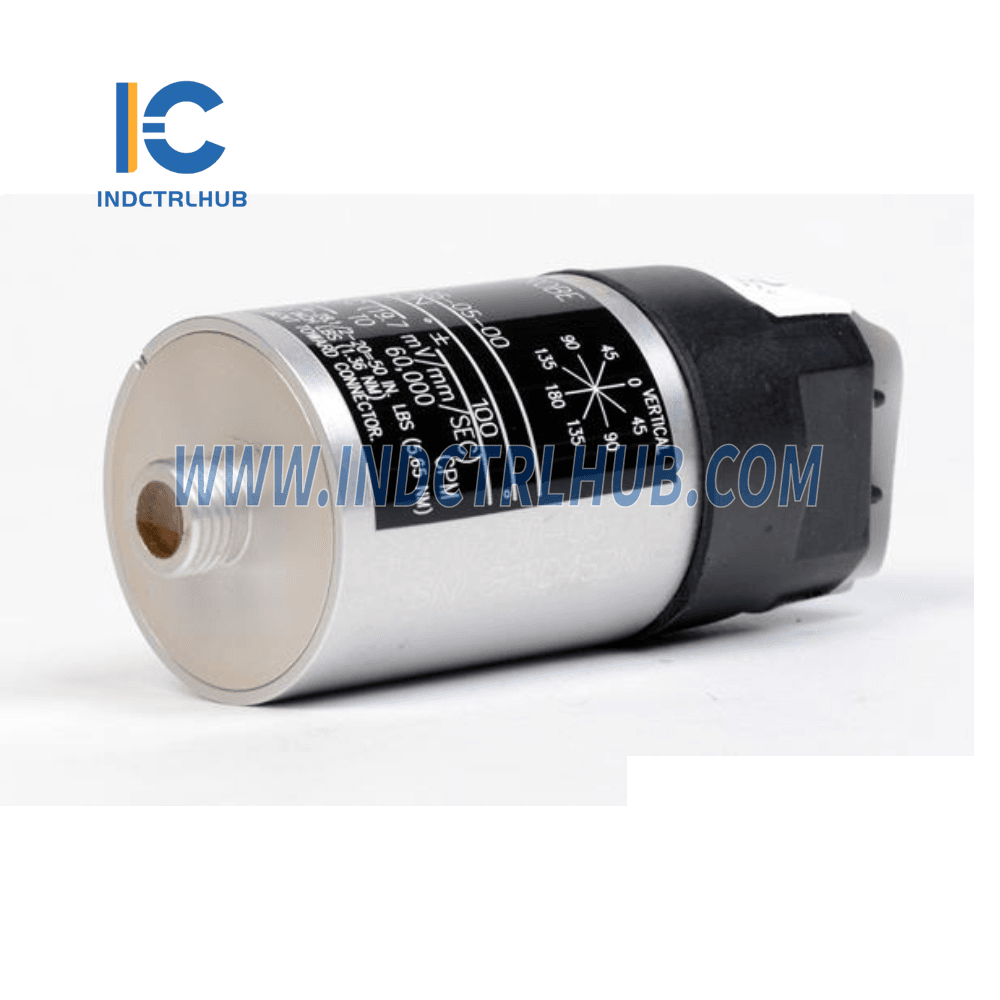
Bently Nevada 9200-03-06-10-00 Seismoprobe Velocity Transducer
Bently Nevada 9200-03-06-10-00 Seismoprobe Velocity Transducer
Manufacturer: Bently Nevada
Product No.: 9200-03-06-10-00
Condition:1000 in stock
Product Type: Velocity Transducer
Product Origin: 8509200030610
Payment: T/T, Western Union
Weight: 300g
Shipping port: Xiamen
Warranty: 12 months
- 24/7 Support
- 30-Day Returns
- Fast Shipping
Bently Nevada 9200-03-06-10-00 Seismoprobe Velocity Transducer
The Bently Nevada 9200-03-06-10-00 is a precision two-wire velocity transducer from the renowned 9200 Seismoprobe series, engineered to deliver accurate vibration measurements in the harshest industrial environments. This self-generating sensor converts mechanical vibration into proportional electrical signals without requiring external power, making it ideal for continuous machinery health monitoring across diverse process industries.
Core Technical Parameters
- Model Designation: 9200-03-06-10-00
- Sensitivity: 20 mV/mm/s (500 mV/in/s) ±5%
- Frequency Response: 4.5 Hz to 1000 Hz (±3 dB)
- Measurement Range: 0 to 50 mm/s RMS (0 to 2.0 in/s RMS)
- Transverse Sensitivity: <5% of axial sensitivity
- Operating Temperature: -51°C to +121°C (-60°F to +250°F)
- Electrical Connection: Two-wire, self-powered design
- Output Impedance: <150 Ω at 100 Hz
- Case Material: 316L stainless steel for corrosion resistance
- Sealing: Hermetically sealed, IP68 rated
- Mounting Thread: 1/4-28 UNF-2A standard
- Weight: Approximately 300 grams
Operational Principles & Design Innovation
The 9200-03-06-10-00 employs a moving-coil electromagnetic design where a precision-balanced seismic mass suspended by calibrated springs generates voltage proportional to velocity. Key design advantages include:
- Self-Generating Technology: No external power required—the sensor generates its own signal through electromagnetic induction, eliminating power supply failures and simplifying installation
- Wide Dynamic Range: Captures both low-frequency imbalance (4.5 Hz) and high-frequency bearing defects (1000 Hz) in a single measurement
- Hermetic Sealing: Welded construction prevents moisture ingress and contamination, ensuring stable performance in humid, corrosive, or washdown environments
- Temperature Compensation: Internal compensation circuitry maintains accuracy across the full -51°C to +121°C operating range
- Rugged Construction: 316L stainless steel housing withstands mechanical shock up to 500g and continuous vibration to 10g RMS
Industrial Application Scenarios
The 9200-03-06-10-00 velocity transducer excels in critical machinery monitoring applications:
Power Generation Facilities
- Steam Turbines: Monitor bearing housing vibration on turbine-generator sets to detect rotor imbalance, misalignment, and bearing wear before catastrophic failure
- Cooling Tower Fans: Track gearbox and motor vibration to schedule predictive maintenance and avoid unplanned outages during peak demand
- Boiler Feed Pumps: Continuous monitoring of multi-stage centrifugal pumps operating at 3600 RPM to prevent cavitation and impeller damage
Petrochemical & Refining
- Compressor Trains: Measure vibration on reciprocating and centrifugal compressors handling flammable gases where sensor reliability is safety-critical
- Process Pumps: Monitor chemical transfer pumps in corrosive service where hermetic sealing prevents sensor degradation
- Cooling Water Systems: Track large circulation pumps in saltwater or brackish water environments requiring IP68 protection
Pulp & Paper Manufacturing
- Paper Machine Dryers: Monitor rotating dryer drums and support bearings in high-humidity environments with frequent washdowns
- Stock Preparation: Track refiners, screens, and agitators operating in wet, corrosive pulp slurries
- Recovery Boilers: Measure induced draft fan vibration in high-temperature exhaust gas streams
Mining & Mineral Processing
- SAG Mills: Monitor gearbox and motor vibration on semi-autogenous grinding mills processing ore 24/7
- Conveyor Systems: Track drive pulley and idler bearing condition across kilometers of material transport
- Slurry Pumps: Measure vibration on abrasive slurry pumps where sensor durability directly impacts maintenance costs
Integrated Monitoring Solutions
The 9200-03-06-10-00 integrates seamlessly with comprehensive vibration monitoring architectures:
- Bently Nevada 3500 Systems: Direct connection to 3500/42M vibration monitors for alarm setpoints, trending, and diagnostics
- Distributed Control Systems: 4-20 mA output conversion enables integration with DCS platforms for centralized monitoring
- Portable Analyzers: Compatible with handheld data collectors for route-based predictive maintenance programs
- Wireless Gateways: Pair with IIoT wireless transmitters for remote monitoring of inaccessible equipment
- SCADA Integration: Modbus/OPC connectivity for plant-wide asset performance management
Installation Guidelines & Best Practices
Proper installation is critical for measurement accuracy and sensor longevity:
Mounting Location Selection
- Install on bearing housing or structural component with direct load path to bearing
- Avoid mounting on thin sheet metal, piping, or non-structural covers that amplify vibration
- Position sensor perpendicular to shaft axis for radial vibration measurement
- Maintain minimum 50mm clearance from other sensors to prevent magnetic interference
Surface Preparation
- Machine mounting surface flat to within 0.025mm (0.001 inch) for optimal coupling
- Clean surface with solvent to remove oil, paint, or corrosion products
- Apply thin layer of petroleum jelly or coupling grease to exclude air gaps
- Torque mounting stud to 5-7 N⋅m (45-60 in⋅lb) using calibrated wrench
Cable Routing & Termination
- Use shielded twisted-pair cable with maximum length of 300 meters (1000 feet)
- Route cables in dedicated conduit separate from power wiring to minimize EMI
- Ground cable shield at monitor end only to prevent ground loops
- Seal cable entry with appropriate gland for environmental rating
Calibration & Verification
Factory calibration ensures measurement accuracy, with field verification recommended:
- Factory Calibration: Each sensor calibrated to NIST-traceable standards with certificate documenting sensitivity within ±5%
- Field Verification: Annual bump test using portable shaker confirms sensor responsiveness
- Baseline Establishment: Record initial vibration signature during commissioning for future trending
- Recalibration Interval: Laboratory recalibration every 3-5 years or after mechanical damage
Troubleshooting & Diagnostics
Common issues and resolution strategies:
- Low Output Signal: Verify mounting torque, check for air gaps, inspect cable continuity
- Erratic Readings: Test cable shield grounding, eliminate ground loops, check for EMI sources
- Temperature Drift: Confirm sensor within operating range, allow thermal stabilization period
- Mechanical Damage: Inspect case for cracks, verify mounting stud integrity, check for impact damage
Spare Parts Strategy
The 9200-03-06-10-00 is a critical spare part for:
- Emergency Replacement: Stock sensors for rapid replacement during unplanned failures to minimize downtime
- Planned Maintenance: Replace sensors showing degraded sensitivity or mechanical damage during scheduled outages
- System Expansion: Add monitoring points to previously unmonitored equipment as reliability programs mature
- Obsolescence Protection: Maintain inventory for legacy systems where newer sensor models may not be compatible
Related Products
| Product | Description | Link |
|---|---|---|
| 9200-01-05-10-00 | Bently Nevada 9200 Seismoprobe Velocity Sensor, 100 mV/mm/s sensitivity | View Product |
| 3500/42E | Bently Nevada 3500 Series Vibration Monitor Module, 4-channel | View Product |
| 330180-91-CN | Bently Nevada 3300 XL Proximitor Sensor for shaft displacement | View Product |
© 2025 INDUSTRIAL CONTROL HUB. All rights reserved.
Original Source: https://www.indctrlhub.com
Contact: sales@indctrlhub.com | +0086 18359243191
Product Description
Bently Nevada 9200-03-06-10-00 Seismoprobe Velocity Transducer
The Bently Nevada 9200-03-06-10-00 is a precision two-wire velocity transducer from the renowned 9200 Seismoprobe series, engineered to deliver accurate vibration measurements in the harshest industrial environments. This self-generating sensor converts mechanical vibration into proportional electrical signals without requiring external power, making it ideal for continuous machinery health monitoring across diverse process industries.
Core Technical Parameters
- Model Designation: 9200-03-06-10-00
- Sensitivity: 20 mV/mm/s (500 mV/in/s) ±5%
- Frequency Response: 4.5 Hz to 1000 Hz (±3 dB)
- Measurement Range: 0 to 50 mm/s RMS (0 to 2.0 in/s RMS)
- Transverse Sensitivity: <5% of axial sensitivity
- Operating Temperature: -51°C to +121°C (-60°F to +250°F)
- Electrical Connection: Two-wire, self-powered design
- Output Impedance: <150 Ω at 100 Hz
- Case Material: 316L stainless steel for corrosion resistance
- Sealing: Hermetically sealed, IP68 rated
- Mounting Thread: 1/4-28 UNF-2A standard
- Weight: Approximately 300 grams
Operational Principles & Design Innovation
The 9200-03-06-10-00 employs a moving-coil electromagnetic design where a precision-balanced seismic mass suspended by calibrated springs generates voltage proportional to velocity. Key design advantages include:
- Self-Generating Technology: No external power required—the sensor generates its own signal through electromagnetic induction, eliminating power supply failures and simplifying installation
- Wide Dynamic Range: Captures both low-frequency imbalance (4.5 Hz) and high-frequency bearing defects (1000 Hz) in a single measurement
- Hermetic Sealing: Welded construction prevents moisture ingress and contamination, ensuring stable performance in humid, corrosive, or washdown environments
- Temperature Compensation: Internal compensation circuitry maintains accuracy across the full -51°C to +121°C operating range
- Rugged Construction: 316L stainless steel housing withstands mechanical shock up to 500g and continuous vibration to 10g RMS
Industrial Application Scenarios
The 9200-03-06-10-00 velocity transducer excels in critical machinery monitoring applications:
Power Generation Facilities
- Steam Turbines: Monitor bearing housing vibration on turbine-generator sets to detect rotor imbalance, misalignment, and bearing wear before catastrophic failure
- Cooling Tower Fans: Track gearbox and motor vibration to schedule predictive maintenance and avoid unplanned outages during peak demand
- Boiler Feed Pumps: Continuous monitoring of multi-stage centrifugal pumps operating at 3600 RPM to prevent cavitation and impeller damage
Petrochemical & Refining
- Compressor Trains: Measure vibration on reciprocating and centrifugal compressors handling flammable gases where sensor reliability is safety-critical
- Process Pumps: Monitor chemical transfer pumps in corrosive service where hermetic sealing prevents sensor degradation
- Cooling Water Systems: Track large circulation pumps in saltwater or brackish water environments requiring IP68 protection
Pulp & Paper Manufacturing
- Paper Machine Dryers: Monitor rotating dryer drums and support bearings in high-humidity environments with frequent washdowns
- Stock Preparation: Track refiners, screens, and agitators operating in wet, corrosive pulp slurries
- Recovery Boilers: Measure induced draft fan vibration in high-temperature exhaust gas streams
Mining & Mineral Processing
- SAG Mills: Monitor gearbox and motor vibration on semi-autogenous grinding mills processing ore 24/7
- Conveyor Systems: Track drive pulley and idler bearing condition across kilometers of material transport
- Slurry Pumps: Measure vibration on abrasive slurry pumps where sensor durability directly impacts maintenance costs
Integrated Monitoring Solutions
The 9200-03-06-10-00 integrates seamlessly with comprehensive vibration monitoring architectures:
- Bently Nevada 3500 Systems: Direct connection to 3500/42M vibration monitors for alarm setpoints, trending, and diagnostics
- Distributed Control Systems: 4-20 mA output conversion enables integration with DCS platforms for centralized monitoring
- Portable Analyzers: Compatible with handheld data collectors for route-based predictive maintenance programs
- Wireless Gateways: Pair with IIoT wireless transmitters for remote monitoring of inaccessible equipment
- SCADA Integration: Modbus/OPC connectivity for plant-wide asset performance management
Installation Guidelines & Best Practices
Proper installation is critical for measurement accuracy and sensor longevity:
Mounting Location Selection
- Install on bearing housing or structural component with direct load path to bearing
- Avoid mounting on thin sheet metal, piping, or non-structural covers that amplify vibration
- Position sensor perpendicular to shaft axis for radial vibration measurement
- Maintain minimum 50mm clearance from other sensors to prevent magnetic interference
Surface Preparation
- Machine mounting surface flat to within 0.025mm (0.001 inch) for optimal coupling
- Clean surface with solvent to remove oil, paint, or corrosion products
- Apply thin layer of petroleum jelly or coupling grease to exclude air gaps
- Torque mounting stud to 5-7 N⋅m (45-60 in⋅lb) using calibrated wrench
Cable Routing & Termination
- Use shielded twisted-pair cable with maximum length of 300 meters (1000 feet)
- Route cables in dedicated conduit separate from power wiring to minimize EMI
- Ground cable shield at monitor end only to prevent ground loops
- Seal cable entry with appropriate gland for environmental rating
Calibration & Verification
Factory calibration ensures measurement accuracy, with field verification recommended:
- Factory Calibration: Each sensor calibrated to NIST-traceable standards with certificate documenting sensitivity within ±5%
- Field Verification: Annual bump test using portable shaker confirms sensor responsiveness
- Baseline Establishment: Record initial vibration signature during commissioning for future trending
- Recalibration Interval: Laboratory recalibration every 3-5 years or after mechanical damage
Troubleshooting & Diagnostics
Common issues and resolution strategies:
- Low Output Signal: Verify mounting torque, check for air gaps, inspect cable continuity
- Erratic Readings: Test cable shield grounding, eliminate ground loops, check for EMI sources
- Temperature Drift: Confirm sensor within operating range, allow thermal stabilization period
- Mechanical Damage: Inspect case for cracks, verify mounting stud integrity, check for impact damage
Spare Parts Strategy
The 9200-03-06-10-00 is a critical spare part for:
- Emergency Replacement: Stock sensors for rapid replacement during unplanned failures to minimize downtime
- Planned Maintenance: Replace sensors showing degraded sensitivity or mechanical damage during scheduled outages
- System Expansion: Add monitoring points to previously unmonitored equipment as reliability programs mature
- Obsolescence Protection: Maintain inventory for legacy systems where newer sensor models may not be compatible
Related Products
| Product | Description | Link |
|---|---|---|
| 9200-01-05-10-00 | Bently Nevada 9200 Seismoprobe Velocity Sensor, 100 mV/mm/s sensitivity | View Product |
| 3500/42E | Bently Nevada 3500 Series Vibration Monitor Module, 4-channel | View Product |
| 330180-91-CN | Bently Nevada 3300 XL Proximitor Sensor for shaft displacement | View Product |
© 2025 INDUSTRIAL CONTROL HUB. All rights reserved.
Original Source: https://www.indctrlhub.com
Contact: sales@indctrlhub.com | +0086 18359243191