

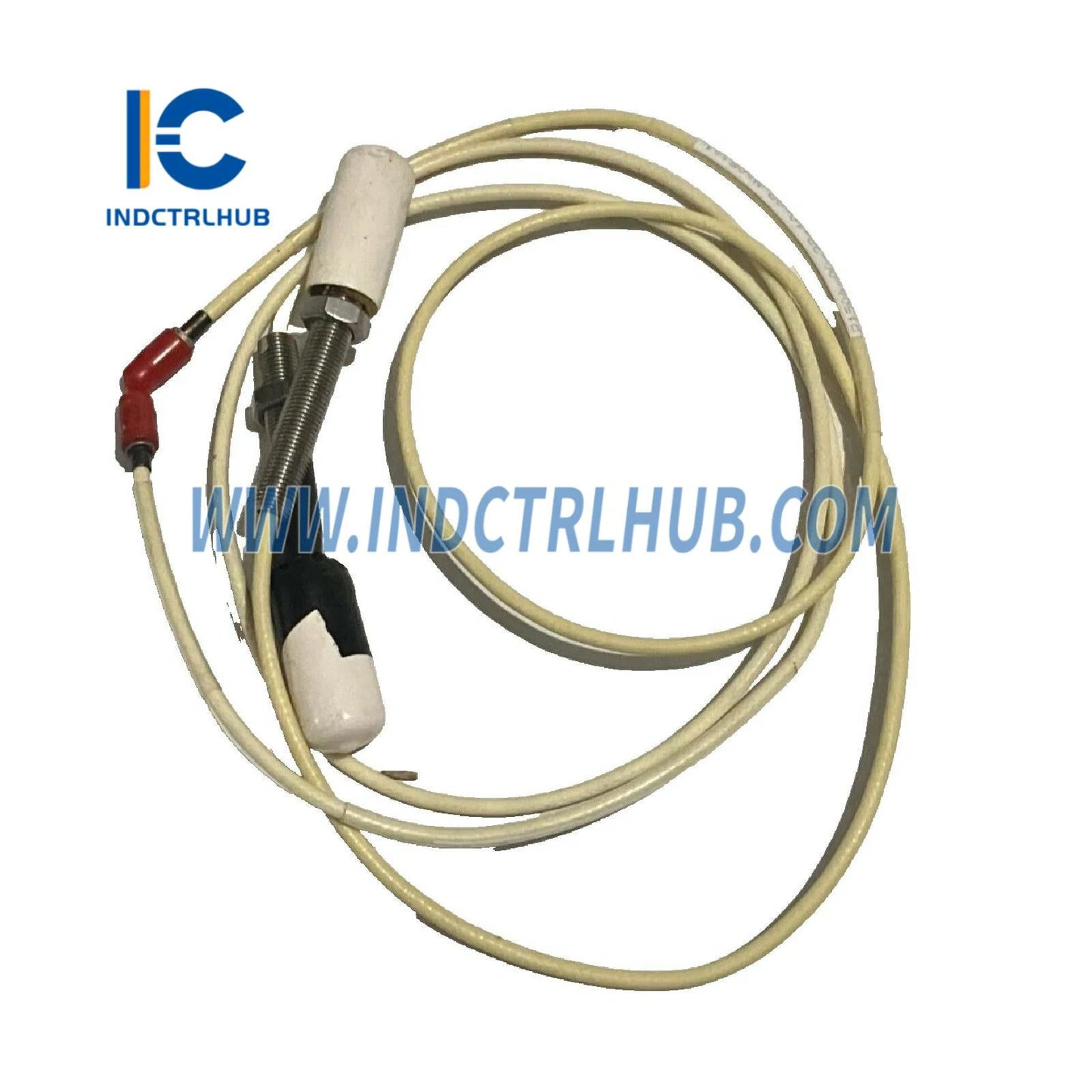
Bently Nevada 21504-00-32-10-02 Proximity Sensor
Bently Nevada 21504-00-32-10-02 Proximity Sensor
Manufacturer: Bently Nevada
Product No.: 21504-00-32-10-02
Condition:1000 in stock
Product Type: Proximity Sensors
Product Origin: 00215040032102
Payment: T/T, Western Union
Weight: 200g
Shipping port: Xiamen
Warranty: 12 months
- 24/7 Support
- 30-Day Returns
- Fast Shipping
Bently Nevada 21504-00-32-10-02 Proximity Transducer System
The Bently Nevada 21504-00-32-10-02 is a high-precision proximity transducer system designed for non-contact vibration and position measurement in rotating machinery. This industrial-grade sensor delivers reliable shaft displacement monitoring for critical turbomachinery applications in power generation, oil & gas, and heavy industry.
Why Proximity Sensors for Machinery Monitoring?
Proximity sensors provide critical early warning of machinery faults before catastrophic failures occur:
- ✅ Non-Contact Measurement – Monitor shaft position without physical contact or wear
- ✅ High Accuracy – Micron-level resolution detects subtle changes in shaft position
- ✅ Wide Frequency Response – Captures both slow roll and high-frequency vibration
- ✅ Harsh Environment Rated – Operates reliably in extreme temperatures and vibration
- ✅ Proven Reliability – Industry-standard technology with decades of field validation
Technical Specifications
| Model Number | 21504-00-32-10-02 |
| System Type | Proximity Transducer System (Probe + Extension Cable + Proximitor) |
| Probe Type | 8mm diameter eddy current probe |
| Probe Length | Standard length (specify during installation) |
| Extension Cable | 32 feet (10 meters) |
| Proximitor Type | 3300 XL series proximitor |
| Measurement Range | 0-80 mils (0-2 mm) typical |
| Frequency Response | 0 Hz to 10 kHz (-3dB) |
| Output Signal | -2V to -18V DC (proportional to gap) |
| Operating Temp | Probe: -40°C to +177°C, Proximitor: -30°C to +65°C |
| Power Supply | -24V DC (via proximitor) |
| Certifications | API 670, ISO 7919, CE, CSA |
| MTBF | >300,000 hours |
Critical Applications
Steam & Gas Turbines
Monitor shaft radial vibration, axial position, and differential expansion in power generation turbines. Detect rotor rubs, bearing failures, and thrust bearing wear before catastrophic damage occurs.
Centrifugal Compressors
Measure shaft displacement in multi-stage compressors for oil & gas processing. Early detection of surge, rotating stall, and aerodynamic instability prevents unplanned shutdowns costing $100K+ per hour.
Large Electric Motors & Generators
Monitor rotor eccentricity and bearing clearances in motors exceeding 1,000 HP. Prevent stator-rotor contact and winding damage in critical drive systems.
Pumps & Fans
Track shaft runout and bearing wear in high-speed pumps and induced draft fans. Predictive maintenance reduces emergency repairs by 60-70%.
System Components
Complete Proximity System Includes
- Proximity Probe (21504-00): 8mm eddy current sensor with threaded mounting
- Extension Cable (32 ft): Low-noise coaxial cable connecting probe to proximitor
- Proximitor (3300 XL): Signal conditioning module converting probe output to industry-standard voltage
- Mounting Hardware: Threaded adapters and lock nuts for secure installation
How the System Works
- Probe Installation: Mount probe perpendicular to shaft surface at specified gap (40 mils typical)
- Eddy Current Sensing: Probe generates electromagnetic field that interacts with conductive shaft material
- Gap Measurement: Changes in shaft position alter eddy current field, changing probe impedance
- Signal Conditioning: Proximitor converts impedance changes to linear voltage output (-2V to -18V)
- Monitoring System: Connect proximitor output to vibration monitor, PLC, or DCS for continuous surveillance
Installation Guidelines
Probe Mounting Best Practices
- Install probe perpendicular to shaft surface (±2° tolerance)
- Set initial gap to 40 mils (1 mm) using feeler gauge or gap voltage method
- Ensure shaft surface is smooth, clean, and free of coatings in measurement area
- Use thread-locking compound to prevent probe loosening from vibration
- Verify probe does not contact shaft during maximum expected vibration
Cable Routing
- Route extension cable away from high-voltage power cables (minimum 12" separation)
- Avoid sharp bends (minimum bend radius: 6 inches)
- Secure cable every 12-18 inches to prevent cable whip
- Use cable glands or conduit for environmental protection
Proximitor Wiring
- Connect -24V DC power supply to proximitor terminals
- Wire proximitor output to monitoring system (4-20mA or voltage input)
- Verify proper grounding to minimize electrical noise
- Use shielded cable for output connections in high-EMI environments
Fault Detection Capabilities
Machinery Faults Detected
- Bearing Wear: Increased shaft vibration amplitude indicates bearing degradation
- Rotor Unbalance: 1× running speed vibration component grows as unbalance worsens
- Misalignment: 2× and 3× running speed harmonics indicate coupling or bearing misalignment
- Rotor Rub: Sudden increase in vibration with sub-synchronous components
- Shaft Crack: 2× running speed vibration with phase shift indicates propagating crack
- Oil Whirl/Whip: Sub-synchronous vibration at 0.43-0.48× running speed
Monitoring Standards
The 21504-00-32-10-02 system complies with:
- API 670: Machinery protection systems for petroleum, chemical, and gas industries
- ISO 7919: Mechanical vibration of non-reciprocating machines
- ISO 10816: Vibration severity standards for rotating machinery
Proximity vs. Accelerometer Sensors
| Feature | Proximity (This Product) | Accelerometer |
|---|---|---|
| Measurement Type | Shaft displacement (absolute) | Bearing housing velocity/acceleration |
| Frequency Range | 0 Hz to 10 kHz (includes DC) | 10 Hz to 10 kHz (no DC response) |
| Installation | Requires shaft access | Mounts on bearing housing (easier) |
| Accuracy | Micron-level resolution | Velocity/acceleration (indirect displacement) |
| Best For | Critical turbomachinery, API 670 compliance | General machinery, predictive maintenance |
| Cost | 💰💰💰 High (complete system) | 💰💰 Medium |
💡 Selection Guide: Use proximity sensors for critical turbomachinery requiring API 670 compliance and absolute shaft position measurement. Use accelerometers for general machinery monitoring where bearing housing vibration is sufficient.
Authenticity & Quality Assurance
⚠️ Counterfeit Sensor Risks
Non-genuine proximity sensors can cause:
- ❌ Inaccurate measurements leading to missed faults or false alarms
- ❌ Premature failure in harsh environments (temperature, vibration)
- ❌ Non-compliance with API 670 and insurance requirements
- ❌ Voided Bently Nevada warranty and technical support
- ❌ Liability issues if machinery failure causes injury or environmental damage
✅ Industrial Control Hub Guarantee
- 🔒 100% Genuine Bently Nevada – Factory-sealed packaging with serial numbers
- 📜 Full Traceability – Certificate of conformity and calibration data
- 🌍 Authorized Distributor – Verify at Baker Hughes/Bently Nevada partner portal
- 🛡️ 24-Month Warranty – Manufacturer warranty honored globally
- 📦 Protective Packaging – Anti-static, shock-resistant shipping containers
- 📞 Technical Support – Application engineering assistance included
Package Contents
- 1× Bently Nevada 21504-00 proximity probe (8mm diameter)
- 1× 32-foot (10m) extension cable
- 1× 3300 XL series proximitor (signal conditioner)
- Mounting hardware (adapters, lock nuts)
- Product documentation and calibration certificate
Not Included: Power supply (-24V DC), mounting brackets, and monitoring system interface cables must be ordered separately.
Related Products
- Vibration Monitors: 3500 series rack-based monitoring systems
- Power Supplies: -24V DC power supplies for proximitor operation
- Mounting Hardware: Probe mounting brackets and adapters for various machine types
- Calibration Tools: Gap voltage meters and calibration fixtures
Technical Support & Services
- 📧 Application Engineering – Email us your machine specifications for sensor placement recommendations
- 📚 Documentation Library – Installation manuals, API 670 compliance guides, vibration analysis tutorials
- 🎓 Training Resources – Proximity sensor fundamentals and troubleshooting courses
- 🔧 Commissioning Support – Remote assistance for initial installation and baseline measurements
- 🔄 30-Day Returns – Unused sensors in original packaging
Frequently Asked Questions
Q: What is the difference between a proximity probe and a proximitor?
A: The probe is the sensor that mounts near the shaft. The proximitor is the signal conditioner that powers the probe and converts its output to a standard voltage signal.
Q: Can I use this sensor on non-ferrous shafts (aluminum, stainless steel)?
A: Yes, eddy current probes work on any conductive material. Calibration may differ from standard steel shaft calibration.
Q: What is the recommended probe gap setting?
A: Typically 40 mils (1 mm) for 8mm probes. This provides ±40 mils of measurement range for shaft displacement.
Q: How often should proximity sensors be calibrated?
A: Annual calibration recommended for critical machinery. API 670 requires verification during major overhauls.
Q: Can I replace just the probe or cable if one component fails?
A: Yes, but the entire system (probe + cable + proximitor) is factory-matched for optimal performance. Mixing components may affect accuracy.
Q: Is this system compatible with 3500 series monitoring racks?
A: Yes, the proximitor output connects directly to 3500 series monitor inputs via standard cabling.
Product Description
Bently Nevada 21504-00-32-10-02 Proximity Transducer System
The Bently Nevada 21504-00-32-10-02 is a high-precision proximity transducer system designed for non-contact vibration and position measurement in rotating machinery. This industrial-grade sensor delivers reliable shaft displacement monitoring for critical turbomachinery applications in power generation, oil & gas, and heavy industry.
Why Proximity Sensors for Machinery Monitoring?
Proximity sensors provide critical early warning of machinery faults before catastrophic failures occur:
- ✅ Non-Contact Measurement – Monitor shaft position without physical contact or wear
- ✅ High Accuracy – Micron-level resolution detects subtle changes in shaft position
- ✅ Wide Frequency Response – Captures both slow roll and high-frequency vibration
- ✅ Harsh Environment Rated – Operates reliably in extreme temperatures and vibration
- ✅ Proven Reliability – Industry-standard technology with decades of field validation
Technical Specifications
| Model Number | 21504-00-32-10-02 |
| System Type | Proximity Transducer System (Probe + Extension Cable + Proximitor) |
| Probe Type | 8mm diameter eddy current probe |
| Probe Length | Standard length (specify during installation) |
| Extension Cable | 32 feet (10 meters) |
| Proximitor Type | 3300 XL series proximitor |
| Measurement Range | 0-80 mils (0-2 mm) typical |
| Frequency Response | 0 Hz to 10 kHz (-3dB) |
| Output Signal | -2V to -18V DC (proportional to gap) |
| Operating Temp | Probe: -40°C to +177°C, Proximitor: -30°C to +65°C |
| Power Supply | -24V DC (via proximitor) |
| Certifications | API 670, ISO 7919, CE, CSA |
| MTBF | >300,000 hours |
Critical Applications
Steam & Gas Turbines
Monitor shaft radial vibration, axial position, and differential expansion in power generation turbines. Detect rotor rubs, bearing failures, and thrust bearing wear before catastrophic damage occurs.
Centrifugal Compressors
Measure shaft displacement in multi-stage compressors for oil & gas processing. Early detection of surge, rotating stall, and aerodynamic instability prevents unplanned shutdowns costing $100K+ per hour.
Large Electric Motors & Generators
Monitor rotor eccentricity and bearing clearances in motors exceeding 1,000 HP. Prevent stator-rotor contact and winding damage in critical drive systems.
Pumps & Fans
Track shaft runout and bearing wear in high-speed pumps and induced draft fans. Predictive maintenance reduces emergency repairs by 60-70%.
System Components
Complete Proximity System Includes
- Proximity Probe (21504-00): 8mm eddy current sensor with threaded mounting
- Extension Cable (32 ft): Low-noise coaxial cable connecting probe to proximitor
- Proximitor (3300 XL): Signal conditioning module converting probe output to industry-standard voltage
- Mounting Hardware: Threaded adapters and lock nuts for secure installation
How the System Works
- Probe Installation: Mount probe perpendicular to shaft surface at specified gap (40 mils typical)
- Eddy Current Sensing: Probe generates electromagnetic field that interacts with conductive shaft material
- Gap Measurement: Changes in shaft position alter eddy current field, changing probe impedance
- Signal Conditioning: Proximitor converts impedance changes to linear voltage output (-2V to -18V)
- Monitoring System: Connect proximitor output to vibration monitor, PLC, or DCS for continuous surveillance
Installation Guidelines
Probe Mounting Best Practices
- Install probe perpendicular to shaft surface (±2° tolerance)
- Set initial gap to 40 mils (1 mm) using feeler gauge or gap voltage method
- Ensure shaft surface is smooth, clean, and free of coatings in measurement area
- Use thread-locking compound to prevent probe loosening from vibration
- Verify probe does not contact shaft during maximum expected vibration
Cable Routing
- Route extension cable away from high-voltage power cables (minimum 12" separation)
- Avoid sharp bends (minimum bend radius: 6 inches)
- Secure cable every 12-18 inches to prevent cable whip
- Use cable glands or conduit for environmental protection
Proximitor Wiring
- Connect -24V DC power supply to proximitor terminals
- Wire proximitor output to monitoring system (4-20mA or voltage input)
- Verify proper grounding to minimize electrical noise
- Use shielded cable for output connections in high-EMI environments
Fault Detection Capabilities
Machinery Faults Detected
- Bearing Wear: Increased shaft vibration amplitude indicates bearing degradation
- Rotor Unbalance: 1× running speed vibration component grows as unbalance worsens
- Misalignment: 2× and 3× running speed harmonics indicate coupling or bearing misalignment
- Rotor Rub: Sudden increase in vibration with sub-synchronous components
- Shaft Crack: 2× running speed vibration with phase shift indicates propagating crack
- Oil Whirl/Whip: Sub-synchronous vibration at 0.43-0.48× running speed
Monitoring Standards
The 21504-00-32-10-02 system complies with:
- API 670: Machinery protection systems for petroleum, chemical, and gas industries
- ISO 7919: Mechanical vibration of non-reciprocating machines
- ISO 10816: Vibration severity standards for rotating machinery
Proximity vs. Accelerometer Sensors
| Feature | Proximity (This Product) | Accelerometer |
|---|---|---|
| Measurement Type | Shaft displacement (absolute) | Bearing housing velocity/acceleration |
| Frequency Range | 0 Hz to 10 kHz (includes DC) | 10 Hz to 10 kHz (no DC response) |
| Installation | Requires shaft access | Mounts on bearing housing (easier) |
| Accuracy | Micron-level resolution | Velocity/acceleration (indirect displacement) |
| Best For | Critical turbomachinery, API 670 compliance | General machinery, predictive maintenance |
| Cost | 💰💰💰 High (complete system) | 💰💰 Medium |
💡 Selection Guide: Use proximity sensors for critical turbomachinery requiring API 670 compliance and absolute shaft position measurement. Use accelerometers for general machinery monitoring where bearing housing vibration is sufficient.
Authenticity & Quality Assurance
⚠️ Counterfeit Sensor Risks
Non-genuine proximity sensors can cause:
- ❌ Inaccurate measurements leading to missed faults or false alarms
- ❌ Premature failure in harsh environments (temperature, vibration)
- ❌ Non-compliance with API 670 and insurance requirements
- ❌ Voided Bently Nevada warranty and technical support
- ❌ Liability issues if machinery failure causes injury or environmental damage
✅ Industrial Control Hub Guarantee
- 🔒 100% Genuine Bently Nevada – Factory-sealed packaging with serial numbers
- 📜 Full Traceability – Certificate of conformity and calibration data
- 🌍 Authorized Distributor – Verify at Baker Hughes/Bently Nevada partner portal
- 🛡️ 24-Month Warranty – Manufacturer warranty honored globally
- 📦 Protective Packaging – Anti-static, shock-resistant shipping containers
- 📞 Technical Support – Application engineering assistance included
Package Contents
- 1× Bently Nevada 21504-00 proximity probe (8mm diameter)
- 1× 32-foot (10m) extension cable
- 1× 3300 XL series proximitor (signal conditioner)
- Mounting hardware (adapters, lock nuts)
- Product documentation and calibration certificate
Not Included: Power supply (-24V DC), mounting brackets, and monitoring system interface cables must be ordered separately.
Related Products
- Vibration Monitors: 3500 series rack-based monitoring systems
- Power Supplies: -24V DC power supplies for proximitor operation
- Mounting Hardware: Probe mounting brackets and adapters for various machine types
- Calibration Tools: Gap voltage meters and calibration fixtures
Technical Support & Services
- 📧 Application Engineering – Email us your machine specifications for sensor placement recommendations
- 📚 Documentation Library – Installation manuals, API 670 compliance guides, vibration analysis tutorials
- 🎓 Training Resources – Proximity sensor fundamentals and troubleshooting courses
- 🔧 Commissioning Support – Remote assistance for initial installation and baseline measurements
- 🔄 30-Day Returns – Unused sensors in original packaging
Frequently Asked Questions
Q: What is the difference between a proximity probe and a proximitor?
A: The probe is the sensor that mounts near the shaft. The proximitor is the signal conditioner that powers the probe and converts its output to a standard voltage signal.
Q: Can I use this sensor on non-ferrous shafts (aluminum, stainless steel)?
A: Yes, eddy current probes work on any conductive material. Calibration may differ from standard steel shaft calibration.
Q: What is the recommended probe gap setting?
A: Typically 40 mils (1 mm) for 8mm probes. This provides ±40 mils of measurement range for shaft displacement.
Q: How often should proximity sensors be calibrated?
A: Annual calibration recommended for critical machinery. API 670 requires verification during major overhauls.
Q: Can I replace just the probe or cable if one component fails?
A: Yes, but the entire system (probe + cable + proximitor) is factory-matched for optimal performance. Mixing components may affect accuracy.
Q: Is this system compatible with 3500 series monitoring racks?
A: Yes, the proximitor output connects directly to 3500 series monitor inputs via standard cabling.