
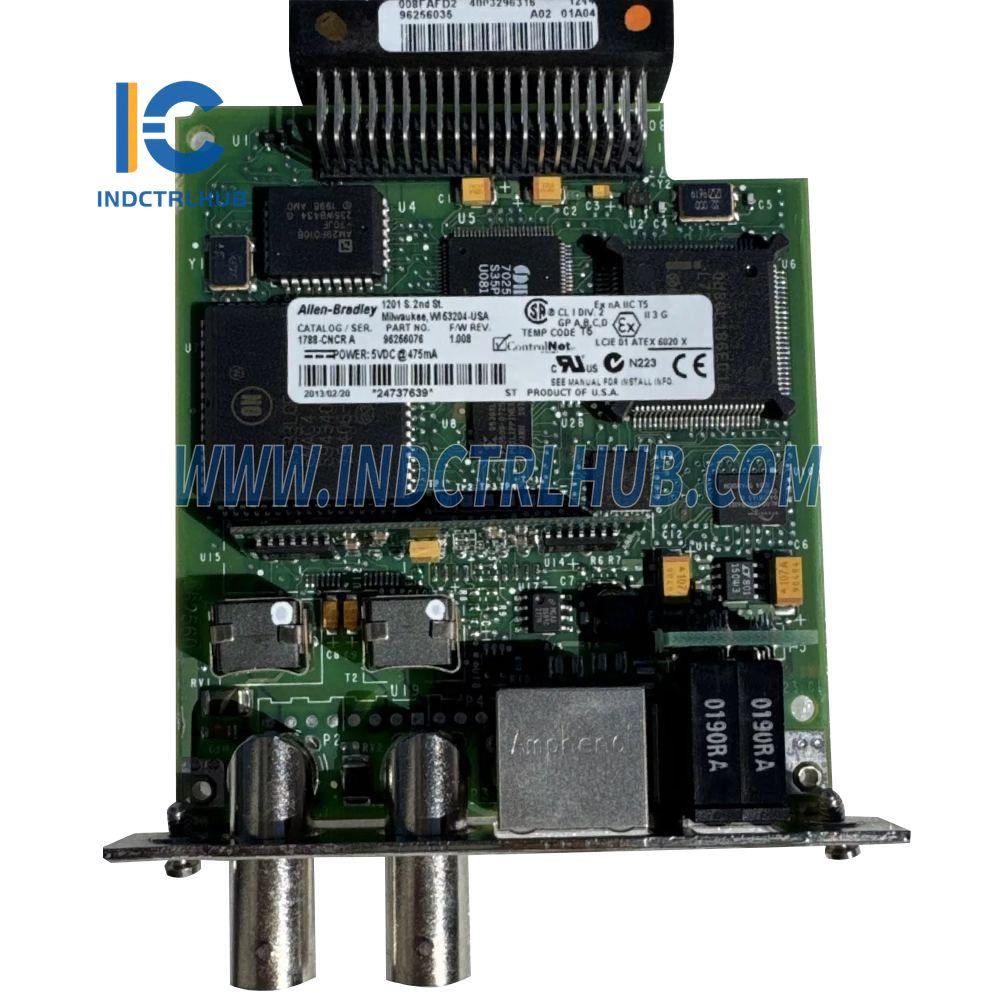
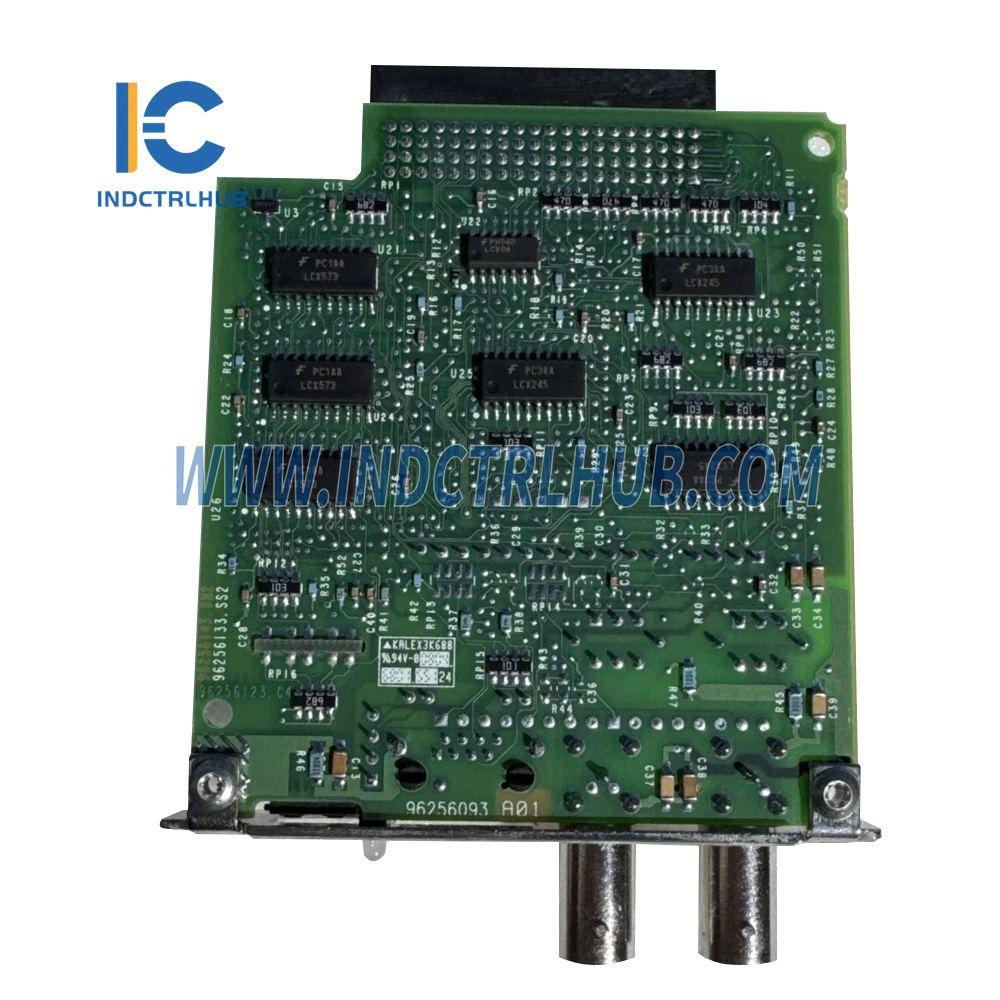
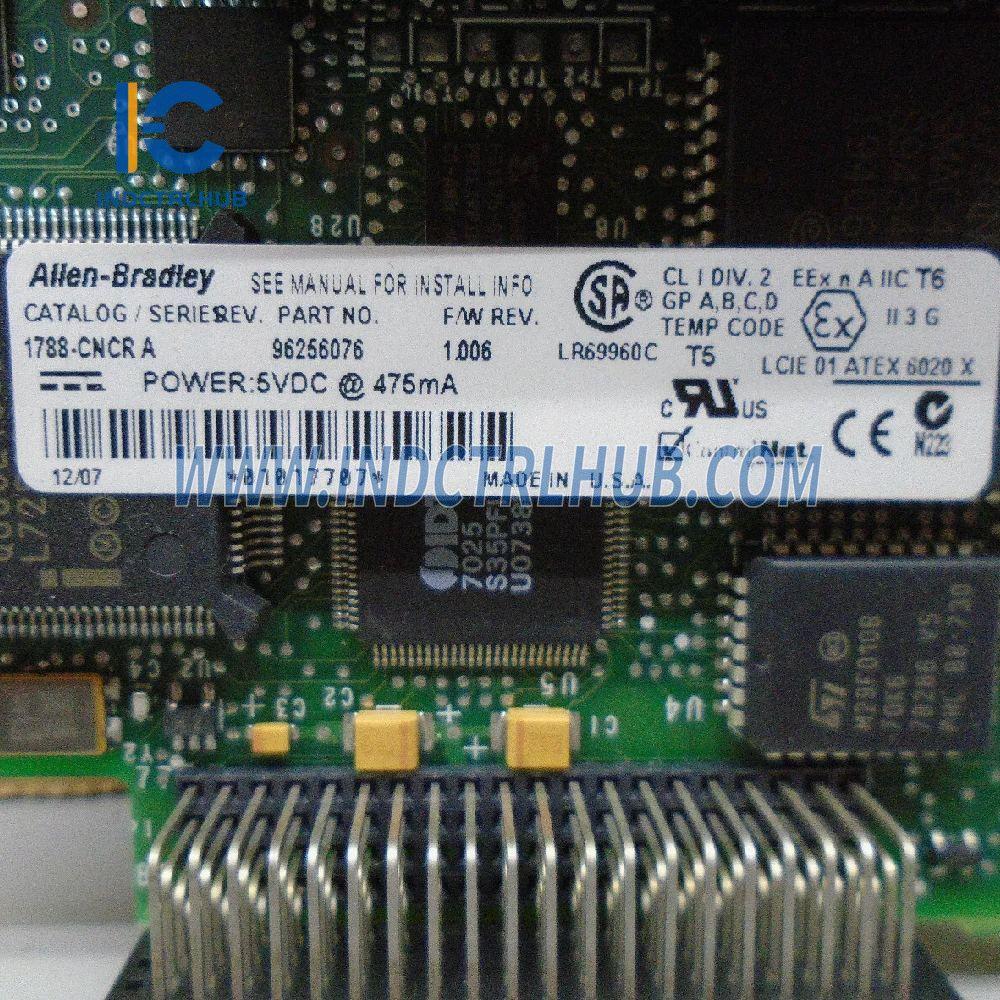
Allen-Bradley 1788-CNCR FlexLogix ControlNet Daughtercard
Allen-Bradley 1788-CNCR FlexLogix ControlNet Daughtercard
Manufacturer: Allen-Bradley
Product No.: 1788-CNCR
Condition:1000 in stock
Product Type: ControlNet Communication Module
Product Origin: 8501788000144
Payment: T/T, Western Union
Weight: 100g
Shipping port: Xiamen
Warranty: 12 months
- 24/7 Support
- 30-Day Returns
- Fast Shipping
Allen-Bradley 1788-CNCR FlexLogix ControlNet Daughtercard
The Allen-Bradley 1788-CNCR is a high-performance ControlNet communication daughtercard engineered for deterministic, real-time data exchange within FlexLogix 1788 controller platforms. This industrial-grade module delivers predictable network performance essential for time-critical manufacturing processes, featuring redundant media support and seamless integration with Rockwell Automation control architectures.
Technical Specifications
- Model Number: 1788-CNCR
- Network Protocol: ControlNet (deterministic scheduled communication)
- Data Transfer Rate: 5 Mbps
- Media Support: Redundant coaxial or fiber optic cable
- Power Consumption: 3.3W at 5V DC
- Thermal Dissipation: 11.3 BTU/Hr
- Network Update Time (NUT): Configurable from 2ms to 100ms
- Maximum Nodes: 99 devices per network segment
- Form Factor: Daughtercard module for FlexLogix 1788 chassis
- Operating Temperature: 0°C to 60°C (32°F to 140°F)
- Storage Temperature: -40°C to 85°C (-40°F to 185°F)
- Relative Humidity: 5% to 95% non-condensing
ControlNet Technology Advantages
The 1788-CNCR leverages ControlNet's unique architecture to deliver superior industrial networking performance:
- Deterministic Communication: Time-slot scheduling guarantees message delivery within predictable timeframes, eliminating network collisions and ensuring consistent scan times
- Concurrent Messaging: Supports both scheduled I/O data and unscheduled messaging on the same network without performance degradation
- Redundant Media: Dual-channel capability provides automatic failover protection, maintaining network integrity even if one cable path fails
- Producer-Consumer Model: Efficient multicast architecture allows one device to broadcast data to multiple consumers simultaneously, reducing network traffic by up to 70%
- Intrinsically Safe Options: Compatible with ControlNet infrastructure approved for hazardous area installations
Application Scenarios
The 1788-CNCR daughtercard excels in applications demanding guaranteed network performance:
- Automotive Assembly Lines: Coordinate motion control, welding robots, and vision systems with microsecond-level synchronization for body-in-white operations
- Batch Process Control: Pharmaceutical and chemical manufacturing requiring precise recipe management and regulatory compliance documentation
- Material Handling Systems: High-speed conveyor networks in distribution centers where package tracking and sortation depend on deterministic communication
- Packaging Machinery: Multi-axis servo coordination for form-fill-seal equipment operating at speeds exceeding 300 packages per minute
- Water Treatment Facilities: SCADA integration for municipal infrastructure requiring redundant communication paths and 24/7 reliability
- Power Generation: Turbine control systems where network latency directly impacts safety shutdown response times
System Architecture & Integration
The 1788-CNCR integrates seamlessly within comprehensive Rockwell Automation control systems:
- FlexLogix Compatibility: Installs directly into 1788 controller chassis, sharing backplane power and communication resources
- ControlLogix Interoperability: Exchanges data with 1756 ControlLogix processors via ControlNet bridge modules for distributed control architectures
- PanelView Integration: Supports direct HMI connectivity for operator interface applications without requiring separate Ethernet infrastructure
- RSNetWorx Configuration: Simplified network setup using Rockwell's graphical configuration software with automatic node address assignment
- Studio 5000 Programming: Unified development environment enables tag-based programming across ControlNet-connected devices
- Third-Party Device Support: Open protocol allows integration of non-Rockwell devices including drives, I/O blocks, and specialty instruments
Network Design Considerations
Optimize ControlNet performance with these engineering best practices:
- Network Update Time Selection: Balance between data freshness and network capacity; 5ms NUT supports up to 48 nodes with typical I/O loads
- Bandwidth Allocation: Reserve 30% of network capacity for unscheduled messaging to prevent scheduled traffic delays
- Cable Topology: Trunk-and-drop configuration supports up to 1000 meters coaxial or 3000 meters fiber between repeaters
- Redundancy Implementation: Configure dual-channel operation for critical paths; system automatically switches to backup within 3ms upon primary failure
- Node Addressing: Assign sequential addresses to minimize configuration complexity; reserve addresses 1-10 for critical controllers
Installation & Commissioning
Proper installation ensures optimal module performance:
- Mechanical Installation: Align daughtercard connector with FlexLogix backplane; secure with captive screws torqued to 7-9 in-lbs
- Cable Termination: Use BNC connectors for coaxial media; ensure fiber optic connectors are clean and properly seated
- Network Termination: Install 75-ohm terminators at both ends of coaxial trunk; fiber networks require no termination
- Configuration Upload: Use RSNetWorx to download network schedule and node parameters; verify green status LED indicates successful communication
- Diagnostic Verification: Monitor network health statistics including packet error rate (should be <0.01%) and scheduled bandwidth utilization
Troubleshooting & Maintenance
Maintain network reliability with systematic diagnostic procedures:
- LED Indicators: Green = normal operation; Red = critical fault; Flashing = configuration mode or communication loss
- Common Issues: Network timeouts often indicate improper termination or excessive cable length; verify physical layer integrity first
- Preventive Maintenance: Inspect BNC connectors quarterly for corrosion; clean fiber optic connectors annually with approved cleaning kits
- Firmware Updates: Check Rockwell Automation website for compatibility patches; update during scheduled maintenance windows
- Replacement Criteria: Replace module if persistent communication errors occur after cable and termination verification
Related Products
| Product | Description | Link |
|---|---|---|
| 1788-DNBO | Allen-Bradley FlexLogix DeviceNet Daughtercard for device-level networking | View Product |
| 1786-XT | Allen-Bradley ControlNet Terminating Resistor for network endpoints | View Product |
| 1756-CNB/D | Allen-Bradley ControlLogix ControlNet Bridge Module for system integration | View Product |
© 2025 INDUSTRIAL CONTROL HUB. All rights reserved.
Original Source: https://www.indctrlhub.com
Contact: sales@indctrlhub.com | +0086 18359243191
Product Description
Allen-Bradley 1788-CNCR FlexLogix ControlNet Daughtercard
The Allen-Bradley 1788-CNCR is a high-performance ControlNet communication daughtercard engineered for deterministic, real-time data exchange within FlexLogix 1788 controller platforms. This industrial-grade module delivers predictable network performance essential for time-critical manufacturing processes, featuring redundant media support and seamless integration with Rockwell Automation control architectures.
Technical Specifications
- Model Number: 1788-CNCR
- Network Protocol: ControlNet (deterministic scheduled communication)
- Data Transfer Rate: 5 Mbps
- Media Support: Redundant coaxial or fiber optic cable
- Power Consumption: 3.3W at 5V DC
- Thermal Dissipation: 11.3 BTU/Hr
- Network Update Time (NUT): Configurable from 2ms to 100ms
- Maximum Nodes: 99 devices per network segment
- Form Factor: Daughtercard module for FlexLogix 1788 chassis
- Operating Temperature: 0°C to 60°C (32°F to 140°F)
- Storage Temperature: -40°C to 85°C (-40°F to 185°F)
- Relative Humidity: 5% to 95% non-condensing
ControlNet Technology Advantages
The 1788-CNCR leverages ControlNet's unique architecture to deliver superior industrial networking performance:
- Deterministic Communication: Time-slot scheduling guarantees message delivery within predictable timeframes, eliminating network collisions and ensuring consistent scan times
- Concurrent Messaging: Supports both scheduled I/O data and unscheduled messaging on the same network without performance degradation
- Redundant Media: Dual-channel capability provides automatic failover protection, maintaining network integrity even if one cable path fails
- Producer-Consumer Model: Efficient multicast architecture allows one device to broadcast data to multiple consumers simultaneously, reducing network traffic by up to 70%
- Intrinsically Safe Options: Compatible with ControlNet infrastructure approved for hazardous area installations
Application Scenarios
The 1788-CNCR daughtercard excels in applications demanding guaranteed network performance:
- Automotive Assembly Lines: Coordinate motion control, welding robots, and vision systems with microsecond-level synchronization for body-in-white operations
- Batch Process Control: Pharmaceutical and chemical manufacturing requiring precise recipe management and regulatory compliance documentation
- Material Handling Systems: High-speed conveyor networks in distribution centers where package tracking and sortation depend on deterministic communication
- Packaging Machinery: Multi-axis servo coordination for form-fill-seal equipment operating at speeds exceeding 300 packages per minute
- Water Treatment Facilities: SCADA integration for municipal infrastructure requiring redundant communication paths and 24/7 reliability
- Power Generation: Turbine control systems where network latency directly impacts safety shutdown response times
System Architecture & Integration
The 1788-CNCR integrates seamlessly within comprehensive Rockwell Automation control systems:
- FlexLogix Compatibility: Installs directly into 1788 controller chassis, sharing backplane power and communication resources
- ControlLogix Interoperability: Exchanges data with 1756 ControlLogix processors via ControlNet bridge modules for distributed control architectures
- PanelView Integration: Supports direct HMI connectivity for operator interface applications without requiring separate Ethernet infrastructure
- RSNetWorx Configuration: Simplified network setup using Rockwell's graphical configuration software with automatic node address assignment
- Studio 5000 Programming: Unified development environment enables tag-based programming across ControlNet-connected devices
- Third-Party Device Support: Open protocol allows integration of non-Rockwell devices including drives, I/O blocks, and specialty instruments
Network Design Considerations
Optimize ControlNet performance with these engineering best practices:
- Network Update Time Selection: Balance between data freshness and network capacity; 5ms NUT supports up to 48 nodes with typical I/O loads
- Bandwidth Allocation: Reserve 30% of network capacity for unscheduled messaging to prevent scheduled traffic delays
- Cable Topology: Trunk-and-drop configuration supports up to 1000 meters coaxial or 3000 meters fiber between repeaters
- Redundancy Implementation: Configure dual-channel operation for critical paths; system automatically switches to backup within 3ms upon primary failure
- Node Addressing: Assign sequential addresses to minimize configuration complexity; reserve addresses 1-10 for critical controllers
Installation & Commissioning
Proper installation ensures optimal module performance:
- Mechanical Installation: Align daughtercard connector with FlexLogix backplane; secure with captive screws torqued to 7-9 in-lbs
- Cable Termination: Use BNC connectors for coaxial media; ensure fiber optic connectors are clean and properly seated
- Network Termination: Install 75-ohm terminators at both ends of coaxial trunk; fiber networks require no termination
- Configuration Upload: Use RSNetWorx to download network schedule and node parameters; verify green status LED indicates successful communication
- Diagnostic Verification: Monitor network health statistics including packet error rate (should be <0.01%) and scheduled bandwidth utilization
Troubleshooting & Maintenance
Maintain network reliability with systematic diagnostic procedures:
- LED Indicators: Green = normal operation; Red = critical fault; Flashing = configuration mode or communication loss
- Common Issues: Network timeouts often indicate improper termination or excessive cable length; verify physical layer integrity first
- Preventive Maintenance: Inspect BNC connectors quarterly for corrosion; clean fiber optic connectors annually with approved cleaning kits
- Firmware Updates: Check Rockwell Automation website for compatibility patches; update during scheduled maintenance windows
- Replacement Criteria: Replace module if persistent communication errors occur after cable and termination verification
Related Products
| Product | Description | Link |
|---|---|---|
| 1788-DNBO | Allen-Bradley FlexLogix DeviceNet Daughtercard for device-level networking | View Product |
| 1786-XT | Allen-Bradley ControlNet Terminating Resistor for network endpoints | View Product |
| 1756-CNB/D | Allen-Bradley ControlLogix ControlNet Bridge Module for system integration | View Product |
© 2025 INDUSTRIAL CONTROL HUB. All rights reserved.
Original Source: https://www.indctrlhub.com
Contact: sales@indctrlhub.com | +0086 18359243191