


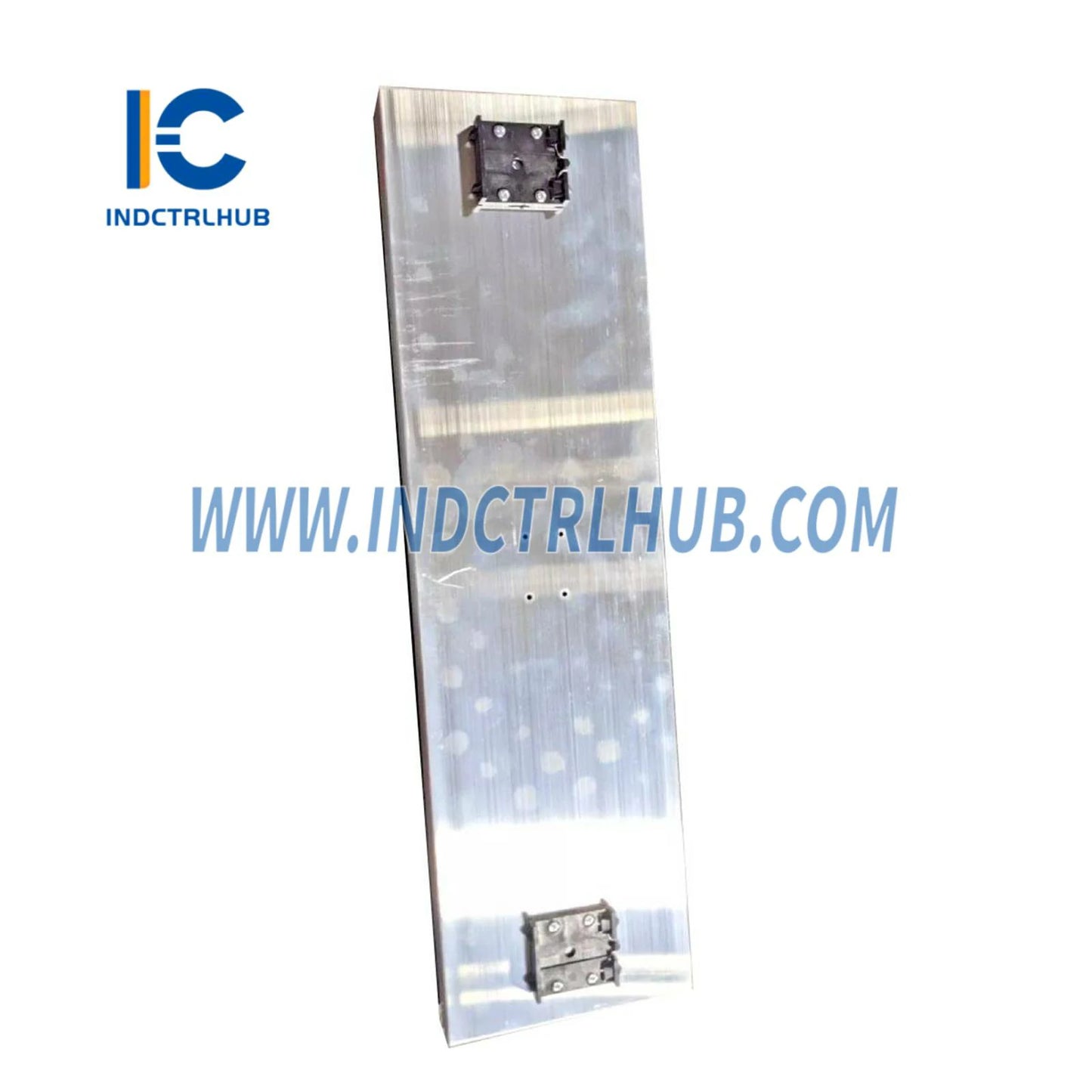
3BHB003041R0101 | ABB UFC719AE01 I/O Control Board IOEC
3BHB003041R0101 | ABB UFC719AE01 I/O Control Board IOEC
Manufacturer: ABB
Product No.: 3BHB003041R0101
Condition:1000 in stock
Product Type: I/O Control Board
Product Origin: 3003041000016
Payment: T/T, Western Union
Weight: 710g
Shipping port: Xiamen
Warranty: 12 months
- 24/7 Support
- 30-Day Returns
- Fast Shipping
ABB UFC719AE01 I/O Control Board IOEC - Precision Signal Processing for Medium Voltage Drives
The ABB UFC719AE01 I/O Control Board (Part Number: 3BHB003041R0101) represents a critical interface component engineered specifically for ACS1000 and ACS2000 medium voltage drive systems. This IOEC (Input/Output Extension Card) module delivers high-precision analog and digital signal conditioning, enabling seamless integration between drive control electronics and field instrumentation in demanding industrial environments requiring megawatt-scale motor control.
Product Identification & Specifications
| Parameter | Details |
|---|---|
| ABB Part Number | 3BHB003041R0101 |
| Type Designation | UF C719 AE / UFC719AE01 |
| Functional Description | I/O Control Board IOEC (Input/Output Extension Card) |
| Product Category | Medium Voltage Drive Control Electronics |
| Compatible Drive Systems | ACS1000 (Special Purpose Drives), ACS2000 (Industrial Drives) |
| Application Quantity | 1 piece per drive system (standard configuration) |
| Country of Manufacture | Slovakia (SK) |
| Customs Tariff Number | 85049099 |
| Product Condition | New, factory-sealed |
| Minimum Order Quantity | 1 piece |
| Unit of Measure | Piece (EA) |
| Net Weight | 0.71 kg |
Superseded Part Numbers
This current-generation UFC719AE01 module replaces the following legacy part numbers:
- HB003041R0001 - Original first-generation IOEC board
- HB003041R0101 - Second-generation revision
- 3BHB003041R0001 - Previous ABB numbering format
Note: The 3BHB003041R0101 version incorporates enhanced EMC filtering, improved thermal management, and extended component lifespan compared to superseded models. Direct retrofit compatibility is maintained with all previous versions.
Functional Architecture & Signal Processing
Core Functionality
The UFC719AE01 IOEC board serves as the primary interface between the drive's digital control system and analog/digital field devices. It performs critical functions including:
- Analog Input Conditioning: Multi-channel signal acquisition with programmable gain amplifiers, anti-aliasing filters, and 16-bit ADC resolution for process feedback (speed reference, torque demand, temperature monitoring)
- Digital I/O Processing: Optically isolated inputs/outputs for start/stop commands, fault signals, status indicators, and interlock logic with 24VDC nominal voltage
- Signal Isolation: Galvanic isolation barriers (typically 2.5kV) between field circuits and control electronics to prevent ground loops and protect sensitive microprocessor systems
- Protocol Conversion: Translates field-level signals into internal drive communication protocols compatible with the main control board (NAMC/NDCU)
- Diagnostic Monitoring: Continuous self-test routines with fault detection for open circuits, short circuits, and out-of-range signal conditions
Signal Channel Architecture (Typical Configuration)
| Channel Type | Quantity | Specifications |
|---|---|---|
| Analog Inputs | 8-12 channels | 0-10V, ±10V, 0-20mA, 4-20mA configurable; 16-bit resolution; 1kHz sampling rate |
| Analog Outputs | 4-6 channels | 0-10V, ±10V, 0-20mA, 4-20mA configurable; 12-bit resolution; isolated outputs |
| Digital Inputs | 16-24 channels | 24VDC nominal (18-30VDC range); optically isolated; 5ms typical response time |
| Digital Outputs | 8-16 channels | 24VDC/2A relay or solid-state; optically isolated; configurable NO/NC logic |
| Communication Interface | 1 port | Proprietary high-speed serial link to main control board (fiber optic or differential) |
Note: Exact channel counts and configurations may vary based on drive model and firmware version. Consult drive-specific documentation for precise I/O mapping.
ACS1000 & ACS2000 Drive System Integration
ACS1000 Special Purpose Drives
The ACS1000 series targets specialized applications requiring precise torque control and four-quadrant operation:
- Marine Propulsion: Azimuth thrusters, podded propulsion, and bow thrusters in cruise ships, ferries, and offshore vessels
- Test Benches: Dynamometer systems for engine testing, transmission validation, and component durability evaluation
- Traction Systems: Railway locomotives, mining haul trucks, and industrial material handling equipment
- Renewable Energy: Wind turbine pitch control, hydroelectric turbine governors, and pumped storage systems
In ACS1000 configurations, the UFC719AE01 processes critical feedback signals including tachometer inputs, load cell measurements, position encoders, and safety interlock circuits. The board's high-resolution analog inputs (16-bit) enable precise closed-loop control essential for torque accuracy within ±0.5% of rated value.
ACS2000 Industrial Drives
The ACS2000 series serves general industrial applications with power ratings from 315kW to 5MW:
- Pumps & Fans: Cooling tower fans, boiler feed pumps, circulating water pumps in power generation and HVAC systems
- Compressors: Centrifugal air compressors, refrigeration chillers, and gas pipeline compression stations
- Conveyors: Belt conveyors, bucket elevators, and material handling systems in mining, cement, and bulk processing
- Mills & Crushers: Ball mills, SAG mills, gyratory crushers, and grinding equipment in mineral processing
For ACS2000 installations, the IOEC board interfaces with process control systems (DCS/SCADA) via 4-20mA analog signals for speed reference and feedback, while digital I/O channels handle permissive logic, alarm outputs, and remote/local mode selection.
Installation & Configuration Guidelines
Physical Installation
-
Pre-Installation Verification:
- Confirm drive model compatibility (ACS1000 or ACS2000 series)
- Verify firmware version supports UFC719AE01 (consult drive manual for minimum required version)
- Inspect board for physical damage, verify anti-static packaging integrity
- Check that replacement board matches existing board revision if upgrading
-
Safety Precautions:
- De-energize drive completely - disconnect main power, control power, and auxiliary supplies
- Wait minimum 10 minutes for DC bus capacitors to discharge (verify with voltmeter)
- Use ESD wrist strap grounded to drive chassis during handling
- Do not touch component leads or connector pins
-
Board Removal (if replacing existing):
- Photograph existing wiring and connector positions for reference
- Label all field wiring with terminal numbers before disconnection
- Remove ribbon cables and communication connectors gently (do not pull on wires)
- Unscrew mounting hardware (typically 4x M3 or M4 screws)
- Carefully extract board from card cage, avoiding contact with adjacent boards
-
New Board Installation:
- Align board with guide rails in card cage, ensure proper seating in backplane connector
- Secure with mounting screws, tighten to 0.5-0.8 Nm torque (do not overtighten)
- Reconnect ribbon cables and communication links per original configuration
- Restore field wiring to screw terminals, verify polarity for analog signals
- Double-check all connections against wiring diagram before power-up
Software Configuration & Commissioning
-
Initial Power-Up:
- Apply control power only (do not energize main power initially)
- Verify board LED indicators show normal status (typically green steady or slow blink)
- Connect drive programming tool (DriveWindow, DriveStudio, or equivalent)
- Perform board recognition test - drive should auto-detect UFC719AE01 presence
-
I/O Channel Configuration:
- Access I/O configuration menu in drive parameter software
- Assign analog input channels to control functions (e.g., AI1 = speed reference, AI2 = torque limit)
- Configure analog input scaling (0-10V = 0-100% speed, 4-20mA = process variable range)
- Set digital input logic (active high/low, normally open/closed)
- Map digital outputs to status/fault conditions (running, fault, ready, at-speed)
- Enable/disable unused channels to prevent false triggering
-
Signal Calibration:
- Apply known reference signals to analog inputs (precision voltage/current source)
- Verify displayed values in drive software match applied signals within ±0.5%
- Adjust offset and gain parameters if necessary (typically auto-calibrated at factory)
- Test digital inputs with 24VDC source, confirm state changes register correctly
- Measure analog output signals with multimeter, verify accuracy under load
-
Functional Testing:
- Perform static I/O test - toggle all digital inputs/outputs, verify correct operation
- Execute dynamic test - ramp analog inputs through full range, monitor drive response
- Test interlock logic - verify safety circuits prevent drive start under fault conditions
- Simulate fault conditions (e.g., loss of speed feedback) and confirm proper alarm generation
- Document all parameter settings and test results for maintenance records
Real-World Application Case Studies
Case Study 1: Cement Plant Ball Mill Drive Retrofit
Challenge: A 3.5MW ball mill drive (ACS2000) experienced intermittent speed fluctuations due to aging IOEC board with degraded analog input circuits. The mill's PLC sent 4-20mA speed reference signals that were being misinterpreted, causing production losses.
Solution: Replaced legacy HB003041R0001 board with current UFC719AE01 (3BHB003041R0101). The new board's improved ADC linearity and enhanced EMC filtering eliminated signal noise. Recalibrated analog input scaling to match PLC output range (4mA = 0 RPM, 20mA = 18 RPM mill speed).
Results: Speed regulation improved from ±3% to ±0.5%, reducing product fineness variation by 40%. Mill availability increased from 87% to 96% due to elimination of nuisance trips. Payback period: 6 months based on increased throughput.
Case Study 2: Marine Thruster Propulsion System Upgrade
Challenge: A cruise ship's azimuth thruster drive (ACS1000, 2.8MW) required enhanced diagnostic capabilities for condition-based maintenance. Existing I/O board lacked sufficient channels for vibration monitoring and bearing temperature sensors.
Solution: Upgraded to UFC719AE01 with expanded analog input capacity. Connected 8x RTD temperature sensors and 4x vibration transducers (4-20mA) to monitor thruster bearing health. Configured digital outputs to trigger alarms in ship's automation system when thresholds exceeded.
Results: Predictive maintenance program detected bearing degradation 3 weeks before failure, allowing planned replacement during scheduled port call instead of emergency dry-docking. Estimated cost avoidance: $850,000 (dry-dock fees + lost revenue).
Case Study 3: Power Plant Cooling Tower Fan Control
Challenge: A 1.2MW induced draft fan drive (ACS2000) needed integration with plant DCS for automated load-following control. Required precise speed modulation based on condenser back-pressure to optimize thermal efficiency.
Solution: Installed UFC719AE01 with 4-20mA analog input from DCS (representing condenser vacuum) and 4-20mA analog output for speed feedback. Programmed PID control loop in drive to maintain setpoint vacuum by adjusting fan speed 10-100%.
Results: Plant heat rate improved by 1.2% (equivalent to 180 kW parasitic load reduction) through optimized cooling. Annual energy savings: $95,000. Control stability within ±0.1 inHg vacuum versus ±0.5 inHg with previous on/off control.
Troubleshooting & Diagnostic Procedures
Common Fault Conditions & Resolutions
| Symptom | Probable Cause | Diagnostic Steps | Resolution |
|---|---|---|---|
| Drive fault: "IOEC Communication Lost" | Loose ribbon cable, board not seated, firmware mismatch | Check LED status on board; verify backplane connector engagement; inspect ribbon cable for damage | Reseat board firmly; replace ribbon cable if damaged; update drive firmware if version incompatible |
| Analog input reads zero or full-scale | Open circuit, wiring error, incorrect scaling | Measure signal at terminal block with multimeter; verify wiring polarity; check parameter settings | Repair field wiring; correct polarity if reversed; adjust scaling parameters to match signal range |
| Digital input not responding | Insufficient voltage, blown fuse, logic inversion | Measure voltage at input terminal (should be 18-30VDC); check internal fuse; verify active high/low setting | Increase supply voltage; replace fuse if blown; invert logic setting in parameters |
| Analog output incorrect value | Load impedance too low, output disabled, calibration drift | Measure output with high-impedance meter; check enable status; verify load resistance >500Ω | Increase load impedance or use signal isolator; enable output in parameters; recalibrate if drift >1% |
| Intermittent signal noise/spikes | EMI from VFD switching, ground loops, inadequate shielding | Observe signals with oscilloscope; check shield grounding; verify cable routing away from power cables | Install ferrite cores on signal cables; ground shields at one end only; reroute cables in separate conduit |
| Board overheating (>70°C) | Inadequate ventilation, excessive ambient temperature, component failure | Measure cabinet temperature; verify fan operation; check for dust accumulation on heatsinks | Improve cabinet cooling; clean air filters; replace board if component failure suspected |
LED Diagnostic Codes
The UFC719AE01 typically features multi-color status LEDs (exact configuration varies by revision):
- Green Steady: Normal operation, communication active, no faults detected
- Green Blinking (1 Hz): Board initializing or in standby mode
- Yellow Steady: Warning condition - check drive event log for details
- Red Steady: Critical fault - board malfunction or communication failure
- Red Blinking: Self-test failure during power-up - board replacement likely required
- No LED: No power to board - check control power supply and fuses
Preventive Maintenance & Lifecycle Management
Recommended Maintenance Schedule
| Interval | Maintenance Activity | Acceptance Criteria |
|---|---|---|
| Monthly | Visual inspection for physical damage, LED status check, terminal tightness verification | No visible damage, green LED status, all terminals secure |
| Quarterly | Analog I/O accuracy verification using calibrated test equipment | All channels within ±1% of applied signal |
| Semi-Annually | Digital I/O functional test, connector inspection, firmware version check | All I/O respond correctly, no corrosion on connectors, firmware up-to-date |
| Annually | Thermal imaging scan, capacitor ESR measurement, full calibration cycle | No hot spots >70°C, capacitor ESR within spec, calibration drift <0.5% |
| Every 5 Years | Electrolytic capacitor replacement (preventive), conformal coating inspection | New capacitors installed, coating intact with no cracks |
Expected Service Life & Reliability
Under normal operating conditions (ambient temperature 25-40°C, 50-70% humidity, clean environment), the UFC719AE01 exhibits:
- MTBF (Mean Time Between Failures): >150,000 hours (17 years continuous operation)
- Design Life: 20+ years with proper maintenance and capacitor replacement at 10-year intervals
- Failure Modes: Most common failures are electrolytic capacitor aging (70%), connector corrosion (15%), and component drift (10%)
- Environmental Derating: For every 10°C above 40°C ambient, expected lifespan reduces by approximately 30%
Spare Parts Strategy
For critical applications where drive downtime costs exceed $10,000/hour, consider:
- On-Site Spare: Maintain 1 spare UFC719AE01 board for immediate replacement (typical swap time: 2-4 hours including reconfiguration)
- Advance Exchange Program: ABB offers 24-hour advance replacement service in most regions (contact local service center)
- Repair Service: Failed boards can often be repaired by ABB authorized service centers (typical turnaround: 2-3 weeks, cost 40-60% of new board)
Technical Documentation & Support Resources
Available Documentation
- Hardware Manual: Detailed board architecture, connector pinouts, jumper settings, and electrical specifications (Document ID: 3BHB003041R0101_HW)
- Installation Guide: Step-by-step installation procedures with safety precautions and torque specifications
- Parameter Reference: Complete listing of I/O configuration parameters with descriptions and valid ranges
- Troubleshooting Guide: Fault code definitions, diagnostic flowcharts, and corrective actions
- Spare Parts List: Recommended spare parts inventory for maintenance planning
- Firmware Release Notes: Version history, bug fixes, and new feature descriptions
Engineering Support Services
ABB provides comprehensive technical support for UFC719AE01 integration and troubleshooting:
- Application Engineering: Pre-sales consultation for I/O requirements analysis and system design
- Commissioning Assistance: On-site or remote support during initial startup and configuration
- Training Programs: Classroom and hands-on training for maintenance personnel (1-3 day courses available)
- 24/7 Technical Hotline: Emergency support for critical failures (response time <2 hours for priority customers)
- Field Service: Certified technicians available for on-site diagnostics, repair, and upgrades
Global Availability & Logistics
Stocking Locations
The UFC719AE01 (3BHB003041R0101) is stocked at multiple ABB distribution centers worldwide for rapid delivery:
- Europe: FIPSEEXPU (Finland) - Primary European distribution hub
- Americas: US Drive Services - North and South America fulfillment
- Asia-Pacific: SGRDC002EXPU (Singapore), CNIAB001EXPU (China), SGIND002EXPU (Singapore), AUABB024EXPU (Australia)
Typical Lead Times: Stock items ship within 1-3 business days. Express shipping available for emergency requirements (additional charges apply).
Packaging & Shipping
- Standard Packaging: Anti-static bag, foam cushioning, cardboard carton with moisture barrier
- Gross Weight: Approximately 1.2 kg including packaging materials
- Carton Dimensions: 250mm × 200mm × 80mm (L × W × H)
- Storage Conditions: -40°C to +85°C, <95% RH non-condensing, avoid direct sunlight
- Shelf Life: Unlimited if stored in original sealed packaging under specified conditions
Complementary Control System Components
Enhance your ABB drive system with these related control and interface products:
| Product | Description | Link |
|---|---|---|
| ACS-CP-A | ABB Assistant Control Panel - Local HMI for drive parameter access and diagnostics | View Control Panel |
| 3BHE024855R0101 | ABB INT-2 Board Varnished UFC921A101 - Interface board for advanced communication protocols | View INT-2 Board |
| NDCU-51C | ABB Drive Control Unit - Main processor board for ACS series drives | View Control Unit |
Warranty & Regulatory Compliance
Warranty Coverage
All new UFC719AE01 boards are covered by ABB's standard warranty:
- Duration: 18 months from date of shipment or 12 months from installation date, whichever occurs first
- Coverage: Defects in materials and workmanship under normal use and service
- Exclusions: Damage from misuse, improper installation, unauthorized modifications, or environmental factors beyond specifications
- Remedy: Repair or replacement at ABB's discretion, no consequential damages covered
- Extended Warranty: Available through ABB Service Agreements (up to 5 years total coverage)
Regulatory Compliance & Certifications
- CE Marking: Complies with EU Low Voltage Directive 2014/35/EU and EMC Directive 2014/30/EU
- UL/cUL Listed: Certified to UL 508C (Power Conversion Equipment) and CSA C22.2 No. 14
- IEC Standards: Designed per IEC 61800-5-1 (Adjustable Speed Electrical Power Drive Systems)
- EMC Compliance: Meets IEC 61800-3 Category C3 (industrial environment) emission and immunity requirements
- RoHS Directive: Compliant with 2011/65/EU (Restriction of Hazardous Substances)
- REACH Regulation: No substances of very high concern (SVHC) above 0.1% threshold
- Marine Approvals: Type-approved by major classification societies (DNV-GL, ABS, Lloyd's Register) for shipboard use


Product Description
ABB UFC719AE01 I/O Control Board IOEC - Precision Signal Processing for Medium Voltage Drives
The ABB UFC719AE01 I/O Control Board (Part Number: 3BHB003041R0101) represents a critical interface component engineered specifically for ACS1000 and ACS2000 medium voltage drive systems. This IOEC (Input/Output Extension Card) module delivers high-precision analog and digital signal conditioning, enabling seamless integration between drive control electronics and field instrumentation in demanding industrial environments requiring megawatt-scale motor control.
Product Identification & Specifications
| Parameter | Details |
|---|---|
| ABB Part Number | 3BHB003041R0101 |
| Type Designation | UF C719 AE / UFC719AE01 |
| Functional Description | I/O Control Board IOEC (Input/Output Extension Card) |
| Product Category | Medium Voltage Drive Control Electronics |
| Compatible Drive Systems | ACS1000 (Special Purpose Drives), ACS2000 (Industrial Drives) |
| Application Quantity | 1 piece per drive system (standard configuration) |
| Country of Manufacture | Slovakia (SK) |
| Customs Tariff Number | 85049099 |
| Product Condition | New, factory-sealed |
| Minimum Order Quantity | 1 piece |
| Unit of Measure | Piece (EA) |
| Net Weight | 0.71 kg |
Superseded Part Numbers
This current-generation UFC719AE01 module replaces the following legacy part numbers:
- HB003041R0001 - Original first-generation IOEC board
- HB003041R0101 - Second-generation revision
- 3BHB003041R0001 - Previous ABB numbering format
Note: The 3BHB003041R0101 version incorporates enhanced EMC filtering, improved thermal management, and extended component lifespan compared to superseded models. Direct retrofit compatibility is maintained with all previous versions.
Functional Architecture & Signal Processing
Core Functionality
The UFC719AE01 IOEC board serves as the primary interface between the drive's digital control system and analog/digital field devices. It performs critical functions including:
- Analog Input Conditioning: Multi-channel signal acquisition with programmable gain amplifiers, anti-aliasing filters, and 16-bit ADC resolution for process feedback (speed reference, torque demand, temperature monitoring)
- Digital I/O Processing: Optically isolated inputs/outputs for start/stop commands, fault signals, status indicators, and interlock logic with 24VDC nominal voltage
- Signal Isolation: Galvanic isolation barriers (typically 2.5kV) between field circuits and control electronics to prevent ground loops and protect sensitive microprocessor systems
- Protocol Conversion: Translates field-level signals into internal drive communication protocols compatible with the main control board (NAMC/NDCU)
- Diagnostic Monitoring: Continuous self-test routines with fault detection for open circuits, short circuits, and out-of-range signal conditions
Signal Channel Architecture (Typical Configuration)
| Channel Type | Quantity | Specifications |
|---|---|---|
| Analog Inputs | 8-12 channels | 0-10V, ±10V, 0-20mA, 4-20mA configurable; 16-bit resolution; 1kHz sampling rate |
| Analog Outputs | 4-6 channels | 0-10V, ±10V, 0-20mA, 4-20mA configurable; 12-bit resolution; isolated outputs |
| Digital Inputs | 16-24 channels | 24VDC nominal (18-30VDC range); optically isolated; 5ms typical response time |
| Digital Outputs | 8-16 channels | 24VDC/2A relay or solid-state; optically isolated; configurable NO/NC logic |
| Communication Interface | 1 port | Proprietary high-speed serial link to main control board (fiber optic or differential) |
Note: Exact channel counts and configurations may vary based on drive model and firmware version. Consult drive-specific documentation for precise I/O mapping.
ACS1000 & ACS2000 Drive System Integration
ACS1000 Special Purpose Drives
The ACS1000 series targets specialized applications requiring precise torque control and four-quadrant operation:
- Marine Propulsion: Azimuth thrusters, podded propulsion, and bow thrusters in cruise ships, ferries, and offshore vessels
- Test Benches: Dynamometer systems for engine testing, transmission validation, and component durability evaluation
- Traction Systems: Railway locomotives, mining haul trucks, and industrial material handling equipment
- Renewable Energy: Wind turbine pitch control, hydroelectric turbine governors, and pumped storage systems
In ACS1000 configurations, the UFC719AE01 processes critical feedback signals including tachometer inputs, load cell measurements, position encoders, and safety interlock circuits. The board's high-resolution analog inputs (16-bit) enable precise closed-loop control essential for torque accuracy within ±0.5% of rated value.
ACS2000 Industrial Drives
The ACS2000 series serves general industrial applications with power ratings from 315kW to 5MW:
- Pumps & Fans: Cooling tower fans, boiler feed pumps, circulating water pumps in power generation and HVAC systems
- Compressors: Centrifugal air compressors, refrigeration chillers, and gas pipeline compression stations
- Conveyors: Belt conveyors, bucket elevators, and material handling systems in mining, cement, and bulk processing
- Mills & Crushers: Ball mills, SAG mills, gyratory crushers, and grinding equipment in mineral processing
For ACS2000 installations, the IOEC board interfaces with process control systems (DCS/SCADA) via 4-20mA analog signals for speed reference and feedback, while digital I/O channels handle permissive logic, alarm outputs, and remote/local mode selection.
Installation & Configuration Guidelines
Physical Installation
-
Pre-Installation Verification:
- Confirm drive model compatibility (ACS1000 or ACS2000 series)
- Verify firmware version supports UFC719AE01 (consult drive manual for minimum required version)
- Inspect board for physical damage, verify anti-static packaging integrity
- Check that replacement board matches existing board revision if upgrading
-
Safety Precautions:
- De-energize drive completely - disconnect main power, control power, and auxiliary supplies
- Wait minimum 10 minutes for DC bus capacitors to discharge (verify with voltmeter)
- Use ESD wrist strap grounded to drive chassis during handling
- Do not touch component leads or connector pins
-
Board Removal (if replacing existing):
- Photograph existing wiring and connector positions for reference
- Label all field wiring with terminal numbers before disconnection
- Remove ribbon cables and communication connectors gently (do not pull on wires)
- Unscrew mounting hardware (typically 4x M3 or M4 screws)
- Carefully extract board from card cage, avoiding contact with adjacent boards
-
New Board Installation:
- Align board with guide rails in card cage, ensure proper seating in backplane connector
- Secure with mounting screws, tighten to 0.5-0.8 Nm torque (do not overtighten)
- Reconnect ribbon cables and communication links per original configuration
- Restore field wiring to screw terminals, verify polarity for analog signals
- Double-check all connections against wiring diagram before power-up
Software Configuration & Commissioning
-
Initial Power-Up:
- Apply control power only (do not energize main power initially)
- Verify board LED indicators show normal status (typically green steady or slow blink)
- Connect drive programming tool (DriveWindow, DriveStudio, or equivalent)
- Perform board recognition test - drive should auto-detect UFC719AE01 presence
-
I/O Channel Configuration:
- Access I/O configuration menu in drive parameter software
- Assign analog input channels to control functions (e.g., AI1 = speed reference, AI2 = torque limit)
- Configure analog input scaling (0-10V = 0-100% speed, 4-20mA = process variable range)
- Set digital input logic (active high/low, normally open/closed)
- Map digital outputs to status/fault conditions (running, fault, ready, at-speed)
- Enable/disable unused channels to prevent false triggering
-
Signal Calibration:
- Apply known reference signals to analog inputs (precision voltage/current source)
- Verify displayed values in drive software match applied signals within ±0.5%
- Adjust offset and gain parameters if necessary (typically auto-calibrated at factory)
- Test digital inputs with 24VDC source, confirm state changes register correctly
- Measure analog output signals with multimeter, verify accuracy under load
-
Functional Testing:
- Perform static I/O test - toggle all digital inputs/outputs, verify correct operation
- Execute dynamic test - ramp analog inputs through full range, monitor drive response
- Test interlock logic - verify safety circuits prevent drive start under fault conditions
- Simulate fault conditions (e.g., loss of speed feedback) and confirm proper alarm generation
- Document all parameter settings and test results for maintenance records
Real-World Application Case Studies
Case Study 1: Cement Plant Ball Mill Drive Retrofit
Challenge: A 3.5MW ball mill drive (ACS2000) experienced intermittent speed fluctuations due to aging IOEC board with degraded analog input circuits. The mill's PLC sent 4-20mA speed reference signals that were being misinterpreted, causing production losses.
Solution: Replaced legacy HB003041R0001 board with current UFC719AE01 (3BHB003041R0101). The new board's improved ADC linearity and enhanced EMC filtering eliminated signal noise. Recalibrated analog input scaling to match PLC output range (4mA = 0 RPM, 20mA = 18 RPM mill speed).
Results: Speed regulation improved from ±3% to ±0.5%, reducing product fineness variation by 40%. Mill availability increased from 87% to 96% due to elimination of nuisance trips. Payback period: 6 months based on increased throughput.
Case Study 2: Marine Thruster Propulsion System Upgrade
Challenge: A cruise ship's azimuth thruster drive (ACS1000, 2.8MW) required enhanced diagnostic capabilities for condition-based maintenance. Existing I/O board lacked sufficient channels for vibration monitoring and bearing temperature sensors.
Solution: Upgraded to UFC719AE01 with expanded analog input capacity. Connected 8x RTD temperature sensors and 4x vibration transducers (4-20mA) to monitor thruster bearing health. Configured digital outputs to trigger alarms in ship's automation system when thresholds exceeded.
Results: Predictive maintenance program detected bearing degradation 3 weeks before failure, allowing planned replacement during scheduled port call instead of emergency dry-docking. Estimated cost avoidance: $850,000 (dry-dock fees + lost revenue).
Case Study 3: Power Plant Cooling Tower Fan Control
Challenge: A 1.2MW induced draft fan drive (ACS2000) needed integration with plant DCS for automated load-following control. Required precise speed modulation based on condenser back-pressure to optimize thermal efficiency.
Solution: Installed UFC719AE01 with 4-20mA analog input from DCS (representing condenser vacuum) and 4-20mA analog output for speed feedback. Programmed PID control loop in drive to maintain setpoint vacuum by adjusting fan speed 10-100%.
Results: Plant heat rate improved by 1.2% (equivalent to 180 kW parasitic load reduction) through optimized cooling. Annual energy savings: $95,000. Control stability within ±0.1 inHg vacuum versus ±0.5 inHg with previous on/off control.
Troubleshooting & Diagnostic Procedures
Common Fault Conditions & Resolutions
| Symptom | Probable Cause | Diagnostic Steps | Resolution |
|---|---|---|---|
| Drive fault: "IOEC Communication Lost" | Loose ribbon cable, board not seated, firmware mismatch | Check LED status on board; verify backplane connector engagement; inspect ribbon cable for damage | Reseat board firmly; replace ribbon cable if damaged; update drive firmware if version incompatible |
| Analog input reads zero or full-scale | Open circuit, wiring error, incorrect scaling | Measure signal at terminal block with multimeter; verify wiring polarity; check parameter settings | Repair field wiring; correct polarity if reversed; adjust scaling parameters to match signal range |
| Digital input not responding | Insufficient voltage, blown fuse, logic inversion | Measure voltage at input terminal (should be 18-30VDC); check internal fuse; verify active high/low setting | Increase supply voltage; replace fuse if blown; invert logic setting in parameters |
| Analog output incorrect value | Load impedance too low, output disabled, calibration drift | Measure output with high-impedance meter; check enable status; verify load resistance >500Ω | Increase load impedance or use signal isolator; enable output in parameters; recalibrate if drift >1% |
| Intermittent signal noise/spikes | EMI from VFD switching, ground loops, inadequate shielding | Observe signals with oscilloscope; check shield grounding; verify cable routing away from power cables | Install ferrite cores on signal cables; ground shields at one end only; reroute cables in separate conduit |
| Board overheating (>70°C) | Inadequate ventilation, excessive ambient temperature, component failure | Measure cabinet temperature; verify fan operation; check for dust accumulation on heatsinks | Improve cabinet cooling; clean air filters; replace board if component failure suspected |
LED Diagnostic Codes
The UFC719AE01 typically features multi-color status LEDs (exact configuration varies by revision):
- Green Steady: Normal operation, communication active, no faults detected
- Green Blinking (1 Hz): Board initializing or in standby mode
- Yellow Steady: Warning condition - check drive event log for details
- Red Steady: Critical fault - board malfunction or communication failure
- Red Blinking: Self-test failure during power-up - board replacement likely required
- No LED: No power to board - check control power supply and fuses
Preventive Maintenance & Lifecycle Management
Recommended Maintenance Schedule
| Interval | Maintenance Activity | Acceptance Criteria |
|---|---|---|
| Monthly | Visual inspection for physical damage, LED status check, terminal tightness verification | No visible damage, green LED status, all terminals secure |
| Quarterly | Analog I/O accuracy verification using calibrated test equipment | All channels within ±1% of applied signal |
| Semi-Annually | Digital I/O functional test, connector inspection, firmware version check | All I/O respond correctly, no corrosion on connectors, firmware up-to-date |
| Annually | Thermal imaging scan, capacitor ESR measurement, full calibration cycle | No hot spots >70°C, capacitor ESR within spec, calibration drift <0.5% |
| Every 5 Years | Electrolytic capacitor replacement (preventive), conformal coating inspection | New capacitors installed, coating intact with no cracks |
Expected Service Life & Reliability
Under normal operating conditions (ambient temperature 25-40°C, 50-70% humidity, clean environment), the UFC719AE01 exhibits:
- MTBF (Mean Time Between Failures): >150,000 hours (17 years continuous operation)
- Design Life: 20+ years with proper maintenance and capacitor replacement at 10-year intervals
- Failure Modes: Most common failures are electrolytic capacitor aging (70%), connector corrosion (15%), and component drift (10%)
- Environmental Derating: For every 10°C above 40°C ambient, expected lifespan reduces by approximately 30%
Spare Parts Strategy
For critical applications where drive downtime costs exceed $10,000/hour, consider:
- On-Site Spare: Maintain 1 spare UFC719AE01 board for immediate replacement (typical swap time: 2-4 hours including reconfiguration)
- Advance Exchange Program: ABB offers 24-hour advance replacement service in most regions (contact local service center)
- Repair Service: Failed boards can often be repaired by ABB authorized service centers (typical turnaround: 2-3 weeks, cost 40-60% of new board)
Technical Documentation & Support Resources
Available Documentation
- Hardware Manual: Detailed board architecture, connector pinouts, jumper settings, and electrical specifications (Document ID: 3BHB003041R0101_HW)
- Installation Guide: Step-by-step installation procedures with safety precautions and torque specifications
- Parameter Reference: Complete listing of I/O configuration parameters with descriptions and valid ranges
- Troubleshooting Guide: Fault code definitions, diagnostic flowcharts, and corrective actions
- Spare Parts List: Recommended spare parts inventory for maintenance planning
- Firmware Release Notes: Version history, bug fixes, and new feature descriptions
Engineering Support Services
ABB provides comprehensive technical support for UFC719AE01 integration and troubleshooting:
- Application Engineering: Pre-sales consultation for I/O requirements analysis and system design
- Commissioning Assistance: On-site or remote support during initial startup and configuration
- Training Programs: Classroom and hands-on training for maintenance personnel (1-3 day courses available)
- 24/7 Technical Hotline: Emergency support for critical failures (response time <2 hours for priority customers)
- Field Service: Certified technicians available for on-site diagnostics, repair, and upgrades
Global Availability & Logistics
Stocking Locations
The UFC719AE01 (3BHB003041R0101) is stocked at multiple ABB distribution centers worldwide for rapid delivery:
- Europe: FIPSEEXPU (Finland) - Primary European distribution hub
- Americas: US Drive Services - North and South America fulfillment
- Asia-Pacific: SGRDC002EXPU (Singapore), CNIAB001EXPU (China), SGIND002EXPU (Singapore), AUABB024EXPU (Australia)
Typical Lead Times: Stock items ship within 1-3 business days. Express shipping available for emergency requirements (additional charges apply).
Packaging & Shipping
- Standard Packaging: Anti-static bag, foam cushioning, cardboard carton with moisture barrier
- Gross Weight: Approximately 1.2 kg including packaging materials
- Carton Dimensions: 250mm × 200mm × 80mm (L × W × H)
- Storage Conditions: -40°C to +85°C, <95% RH non-condensing, avoid direct sunlight
- Shelf Life: Unlimited if stored in original sealed packaging under specified conditions
Complementary Control System Components
Enhance your ABB drive system with these related control and interface products:
| Product | Description | Link |
|---|---|---|
| ACS-CP-A | ABB Assistant Control Panel - Local HMI for drive parameter access and diagnostics | View Control Panel |
| 3BHE024855R0101 | ABB INT-2 Board Varnished UFC921A101 - Interface board for advanced communication protocols | View INT-2 Board |
| NDCU-51C | ABB Drive Control Unit - Main processor board for ACS series drives | View Control Unit |
Warranty & Regulatory Compliance
Warranty Coverage
All new UFC719AE01 boards are covered by ABB's standard warranty:
- Duration: 18 months from date of shipment or 12 months from installation date, whichever occurs first
- Coverage: Defects in materials and workmanship under normal use and service
- Exclusions: Damage from misuse, improper installation, unauthorized modifications, or environmental factors beyond specifications
- Remedy: Repair or replacement at ABB's discretion, no consequential damages covered
- Extended Warranty: Available through ABB Service Agreements (up to 5 years total coverage)
Regulatory Compliance & Certifications
- CE Marking: Complies with EU Low Voltage Directive 2014/35/EU and EMC Directive 2014/30/EU
- UL/cUL Listed: Certified to UL 508C (Power Conversion Equipment) and CSA C22.2 No. 14
- IEC Standards: Designed per IEC 61800-5-1 (Adjustable Speed Electrical Power Drive Systems)
- EMC Compliance: Meets IEC 61800-3 Category C3 (industrial environment) emission and immunity requirements
- RoHS Directive: Compliant with 2011/65/EU (Restriction of Hazardous Substances)
- REACH Regulation: No substances of very high concern (SVHC) above 0.1% threshold
- Marine Approvals: Type-approved by major classification societies (DNV-GL, ABS, Lloyd's Register) for shipboard use